Who they are
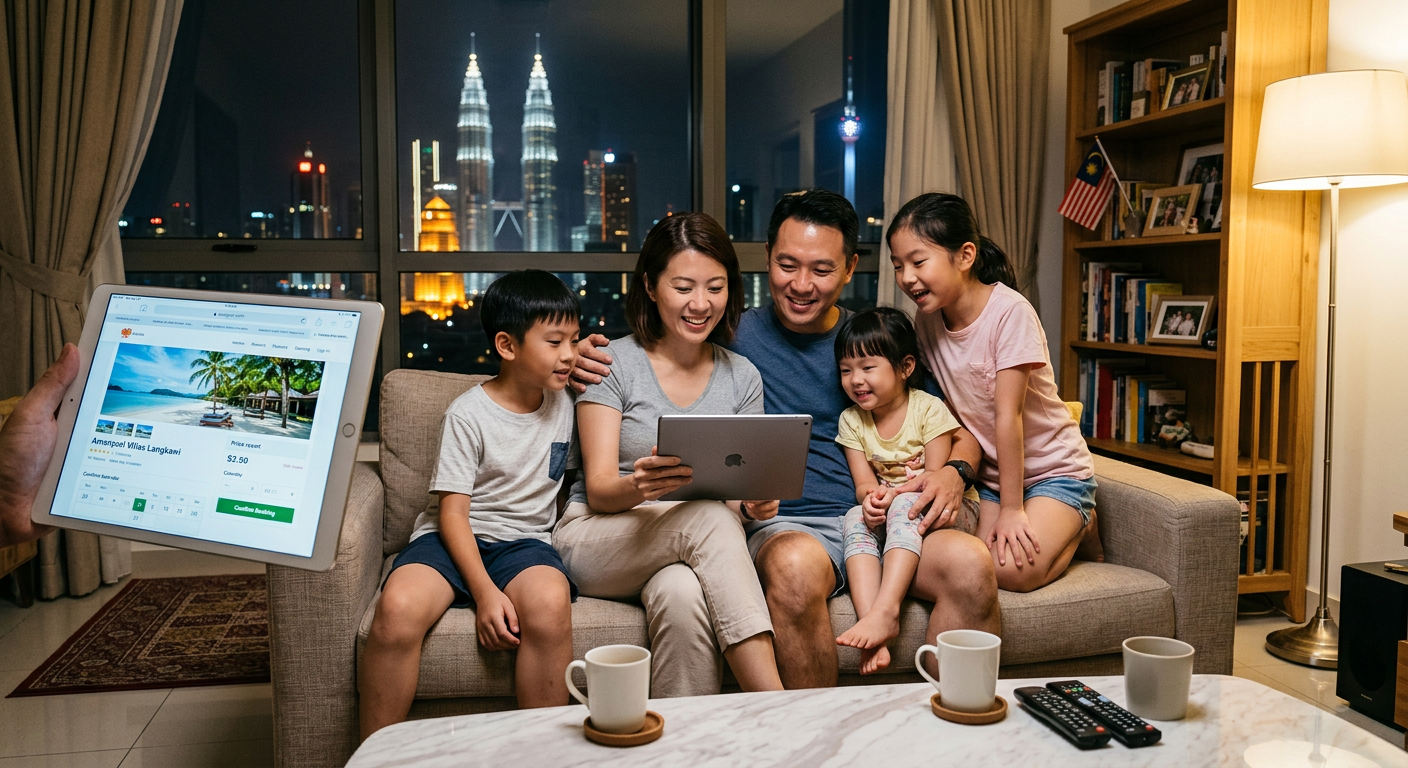
Vacation home bookers in Malaysia are defined by their passion for travel and their investment in domestic space. They are a Millennial-heavy, urban segment with medium income concentration and a distinctive combination of home ownership interests and travel behaviour.
45% are Millennials, which puts them in their late 20s to early 40s — peak earning and family-building years. Another 31% are Gen X. They are younger-middling adults, not the older travellers that property ownership might suggest.
56% are male, 44% female. This is a moderately male-skewing segment without the extreme gender imbalances of beer or cigarette segments.
Income is concentrated in the middle: 40% medium and 22% high. They are not a luxury segment — they are mainstream middle-income travellers who have chosen to invest in vacation property as part of their lifestyle.
34% live in couple households and 33% in nuclear families. They are primarily couples and young families — people who have chosen domestic stability alongside their travel habit.
38% live in cities with over 1 million inhabitants. They are concentrated in urban centres where vacation property ownership, travel culture, and digital commerce are most developed.
What they care about
Having a good time leads at 59% — the highest of any travel segment and well above average. An honest and respectable life scores 55% and a happy relationship 46%. They are experience-seekers who value enjoyment and domestic stability simultaneously.
Their interests reflect both their travel habit and their property ownership. Travel leads at 64%, home and garden at 62%, and food and dining at 56%. Science and technology at 53% and movies, TV, and music at 52% show broad cultural engagement.
Gardening and plants is their top hobby at 47%, followed by traveling at 59% and cars and vehicles at 34%. They are home-oriented people who also love to travel — the vacation home is the intersection of both passions.
57% book accommodations, car rentals, and similar services spontaneously via smartphone when traveling. This is the defining behavioural trait: they are not advance planners — they decide and book in the moment, on mobile.
On national concerns, the economic situation leads at 73%, poverty at 70%, and crime at 68%. Housing scores 52% — notably above average, consistent with their status as property owners concerned about the property market.
41% have right-leaning political views, consistent with their property ownership and conservative financial orientation.
Where to reach them
The channels that work
Radio is the standout traditional channel: vacation home bookers remember hearing ads on the radio more often than the average consumer. Drive-time radio and audio advertising reach this segment during their commute and leisure hours.
Video games are the standout digital channel: above-average ad recall in video games. Gaming environments, esports partnerships, and gaming creator integrations are uniquely effective for this segment.
Social media is the second-strongest digital channel: they interact with companies on social media more than average. They follow brands, engage with content, and are reachable through social advertising.
They consume all types of media more frequently than average — one of the most media-engaged of the travel segments. Print, radio, video streaming, and digital music all perform above average.
The channels that underperform
Daily newspapers at 17% are below average. Print newspapers are not an effective channel for this travel-oriented segment.
Device reality
Smartphone at 97% is universal. Desktop PC at 61% and laptop at 65% are both slightly above average. Gaming console at 33% is average.
What to do
Mobile-first spontaneous booking is critical. 57% book via smartphone when traveling, spontaneously. Your mobile app and mobile booking experience must be fast, frictionless, and optimised for last-minute bookings. This is not an advance-planning segment.
Radio advertising works for this segment. Strong radio ad recall means audio advertising, podcast sponsorships, and drive-time radio spots are effective channels for reaching this urban, mobile segment.
Gaming environments are an underrated channel. Above-average video game ad recall is unusual for a travel segment. Gaming site sponsorships and esports partnerships offer a distinctive way to reach this segment in an engaged context.
Travel brands targeting this segment should emphasise home and garden relevance. Their home and garden interest (62%) is unusually high for a travel segment. Messaging that connects travel experiences to home life — travel as an extension of the home and garden lifestyle — will resonate.
What not to do
Do not assume vacation home bookers are high-net-worth individuals. Medium income concentration means they are value-conscious travellers who have prioritised property investment. They may be stretching financially to maintain vacation property.
Do not ignore the spontaneous booking behaviour. 57% spontaneous booking means advance-planning marketing campaigns (early bird discounts, long-lead promotions) will not capture this segment as effectively as last-minute availability and mobile-first offers.
Do not treat this segment as purely travel-focused. Their home and garden interest is as high as their travel interest. Home brands — furniture, garden, home improvement — can reach this segment through travel-adjacent marketing.